Undergraduate and Postgraduate students, Research Associates and Staff at the Imperial College London High Energy Physics Group. (everyone is invited to add comments!)
For the last week or so the Higgs has been hitting the headlines, but it's also been an amazing year in the world of neutrinos, and last month, a group of us from Imperial attended the Neutrino 2012 conference in Kyoto, which is where the whole community comes together to report and discuss our work, and think about the future.
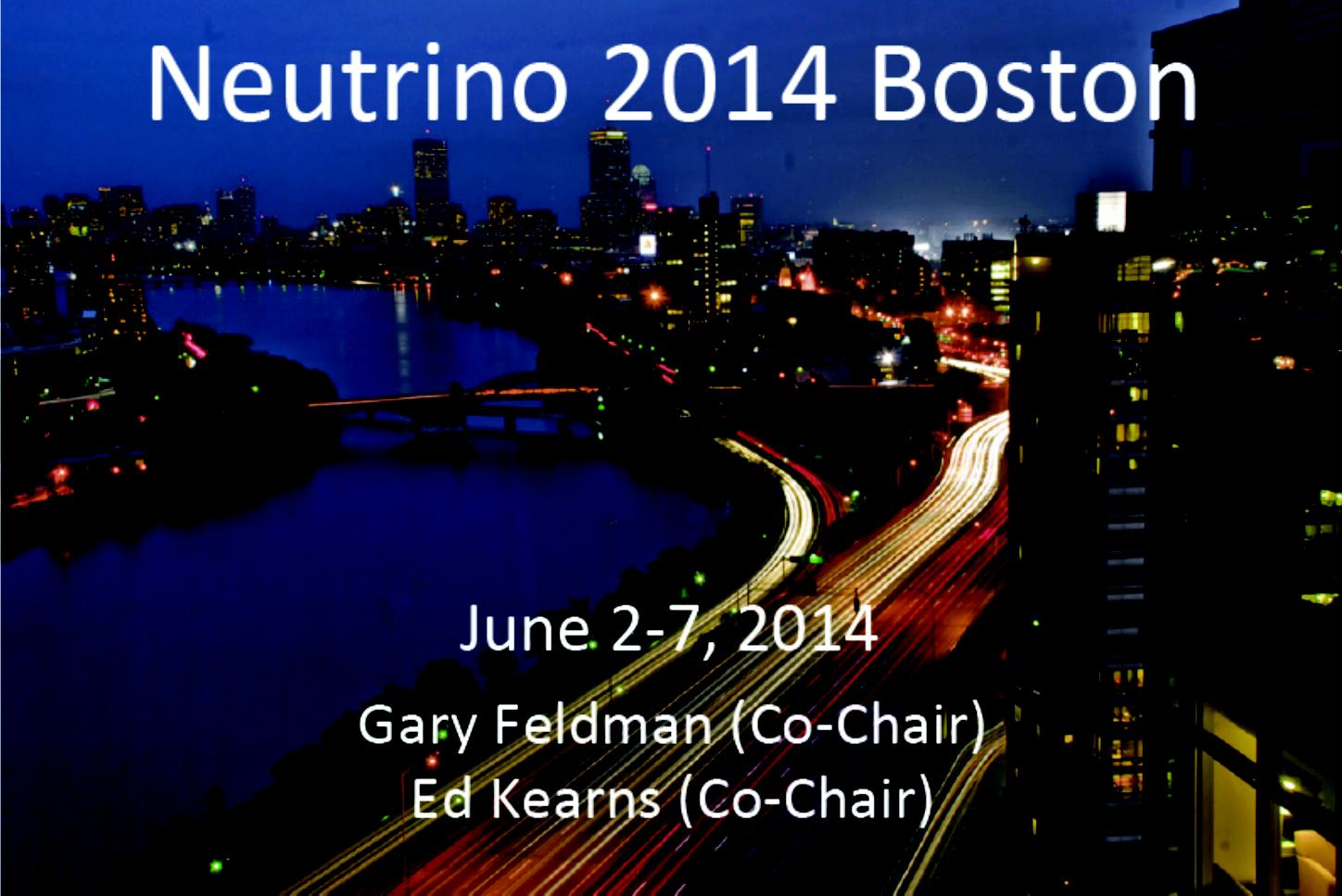
This was the 25th in the Neutrino series of conferences, which are held every other year and are the biggest and most prestigious in the field of neutrinos. In 2014 it will be held jointly by Boston University, Harvard, MIT and Tufts, and in 2016 it will be those of us here at Imperial College London who will be hosting*. We have already started making plans for 2016, so this year at Kyoto, my colleagues and I were thinking not just about the physics, but also the logistics of the conference, the good things we encountered, and any issues that we might be able to improve when it is our turn:
Anyway, this year, over 600 physicists participated, making it the best attended Neutrino conference ever, and the physics results from the past two years that were reported are really reshaping our view of the Universe and also how we should perform experiments in the future to learn even more.
Here are some pictures of Kyoto as found in slides shown by some of the speakers during the conference:
And finally, one of the most beautiful slides of all:
Overall, it was a fabulous conference, with all sorts of ideas sprouting forward from the community on the sorts of things we can do next to take the next steps forward—many of these will result in new experiments, and many will result in new interpretations for previous and current experiments, including these ones we are working on here at Imperial.
The big question with the Higgs and the LHC is “are we seeing something beyond the Standard Model”, but in neutrinos we've been looking well beyond the Standard Model, and now that we actually know all three mixing angles, it may not be long before we uncover a few more fundamental mysteries of the Universe....
*which is to say the Neutrino conferences from now till then are following me round the world!
The other day we had our HEP group party as we do every year, with about 80 group members and guests participating.
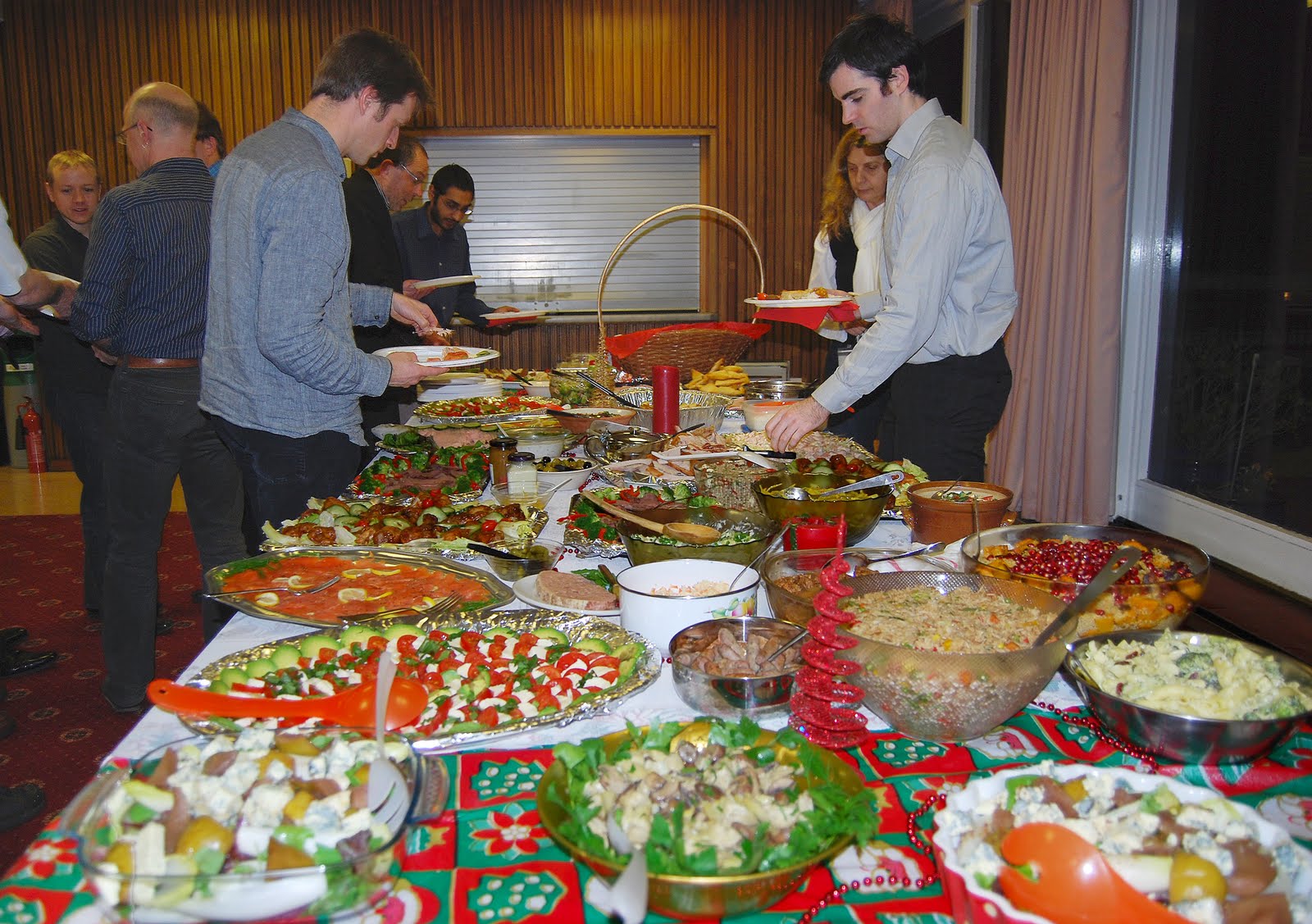
The dinner buffet is always the centrepiece of the party, with dozens of hand-made dishes and puddings brought in by group members for everyone to enjoy.
The first year PhD students provided the main entertainment for the party, with their "Pin the Higgs" game, where we all queued up in front of a Higgs Boson mass plot to pin on it our "predictions", while blindfolded—although the clustering in the 120+ GeV range did indicate that this analysis wasn't as blind as it was meant to be!
Whoever is closest if the LHC experiments discover the Higgs will win something highly coveted, I hear....
This is Paula going for the win:
New results were published from LHCb last week which will help physicists to simulate proton-proton collisions at the Large Hadron Collider. Members of the Imperial HEP group have measured two ratios of strange particles which give clues about how hadrons are produced.
The huge energy of LHC collisions allow physicists to look deep inside the protons to see interactions between the constituent quarks and gluons. Good predictions can be made for these high energy interactions using the theory of Quantum Chromodynamics (QCD).
Sometimes, the interactions of partons can produce "resonances", heavy particles like Z bosons which can decay to produce a shower of quarks and gluons:
Illustration of an LHC proton-proton collision.
These many-particle events are extremely hard to predict because of a surprising property of QCD: low energy interactions occur with more strength. If gravity behaved like this, you could make yourself heavier by moving more slowly, or lighter by running very fast -- sort of like a fat couch potato compared with a trim Olympic athlete.
As more and more quarks and gluons are produced their share of the available energy becomes less and less and the interactions get stronger and stronger until the quarks become "trapped" in groups of two (called mesons) or three (called baryons), just like the partons originally inside the colliding protons. This process is called hadronisation.
Hadronisation involves so many interactions that we cannot use QCD theory to predict what will happen. Instead we use approximate models:
“The predictions of the model are reasonable enough physically that we expect it may be close enough to reality to be useful in designing future experiments and to serve as a reasonable approximation to compare to data. We do not think of the model as a sound physical theory . . . ” – Richard Feynman and Rick Field, 1978
A popular model connects up all the partons with a "string" which snaps to produce mesons and baryons:
Hadronisation of a parton shower.
These models need to be tested against real experimental results. LHCb's strange particle results are useful because the strange quarks sit in a Goldilocks zone where they are light enough to be produced by the hadronisation process and yet do not provide a net contribution to the structure of the colliding protons.
The first ratio anti-Λ/Ks compares how often strange quarks end up in groups of 3 (the anti-Λ baryon) or in groups of 2 (the Ks meson):
This ratio is much higher in data than predicted by hadronisation models, so the models must be underestimating how often strange quarks group into 3s. And this underestimate gets worse with higher particle momentum (perpendicular to the proton beams).
The second ratio anti-Λ/Λ, compares how many times anti-strange quarks group in 3s compared to strange quarks. Protons are made of quarks, not anti-quarks (really less anti-quarks), so it should be easier to make Λ than anti-Λ. This behaviour changes with the angle to the proton beam, or the "rapidity" -- think of large rapidity as a small angle to the proton beam and small rapidity as a large angle.
LHCb is unique amount the LHC experiments with a view of the high rapidity (small angle) region. The anti-baryon/baryon ratio shows a significant change in behaviour across this region. At small rapidity data matches models which have already been validated at the Tevatron but at high rapidity the best match is PerugiaNOCR, a model with localised hadronisation, which uses shorter strings that don't connect all the partons together.
These results will be of great use to future developments of hadronisation models. It is very important to have accurate predictions at the LHC in order to test the Standard Model and search for new physics.
If you want to read more, you can get a copy of the paper for free. You may know that this is not generally the case for scientific publications. CERN has made special arrangements for all LHC results to be made freely available to the general public, in line with the spirit of its founding charter:
“The Organization shall provide for collaboration among European States in nuclear research of a pure scientific and fundamental character, and in research essentially related thereto. The Organization shall have no concern with work for military requirements and the results of its experimental and theoretical work shall be published or otherwise made generally available.” – Convention for the establishment of a European organization for nuclear research, Article II, Section 1, Paris, 1 July 1953
Physics results are what our experiments are all about, and after many years of toil (as mentioned many a time here), it is a wonderful feeling, as always, to present to the world something about our Universe that no one ever seen before.
In the T2K Experiment, we create a beam of muon neutrinos at the J-PARC laboratory at Tokai Village on the eastern coast of Japan, and send them to the Super-Kamiokande neutrino detector 295 km away in the mountains of the north-western part of the country. The mathematics that seem to describe well the results of other experiments—including Super-K looking at neutrinos in the atmosphere, KamLAND (my previous experiment) and many earlier experiments looking at neutrinos from nuclear reactors, SNO and others looking at neutrinos from the Sun, and MINOS and K2K with neutrinos made in a similar way to T2K but with different optimisations—suggest that with the specific energy and distance that the T2K neutrino beam has, we might be able to see a small fraction of the muon neutrinosturn into electron neutrinos.
This effect would be the third type of neutrino oscillation that has been seen. The fact that it is the third type may make it sound boring and unimportant, but actually it is quite the opposite—the aforementioned maths tells us that if we see three, we have seen them all and that means that various other phenomena can be explained when you plug the numbers, that are given by the experiments, into the maths.
One of these possible phenomena we may be able to explain is the existence of matter in the Universe today, as opposed to all the matter and anti-matter produced in the Big Bang just annihilating into almost nothing, which is one reason we think it is rather interesting to measure these things.
Neutrinos, on the rare occasions when they indicate their existence by colliding with the atoms that make up matter instead of just passing through it, tend to create the particles that they are labelled with in their names—muon neutrinos create muons, and electron neutrinos create electrons—Super-Kamiokande is very good at distinguishing muons from electrons, so we basically point the beam at Super-K and count the number of times we see electrons created by neutrinos.
Of course, it isn’t quite that simple—the beam is pretty messy to start with and hard to understand (just like almost anything that has to do with neutrinos), and lots of other things can mimic electrons created by neutrinos, and it is the job of we experimental physicists to do our best to sort these issues out, and most importantly, understand them enough that we can estimate what their effects are.
Once we do all that, we get the plot that is shown at the top of this blog entry. This is what we have worked so hard for so many years for!
We previously calculated that if this third type of neutrino oscillation doesn’t exist, we would have seen about 1.5 electron neutrinos (on average) in the data we took over the year or so since the T2K beam started. That is the shown in the plot above by the yellow, green and blue hatched areas.
One and a half.
But in fact, when we looked at the actual data collected, we saw 6, as shown by the black points in the plot above.
SIX!
This is consistent with this new type of neutrino oscillation occurring!
If we put in this new neutrino oscillation at quite a large level, it looks like the red region in this plot: which shows that the data does look a lot like neutrino oscillations!
But....
Here I have to make it clear that what we see now amounts to what we refer to in physics as an “indication” or a “tantalising hint” to employ a common cliche.
We set up experiments to learn about the Universe, but it often doesn’t just respond with simple “yes” or “no” answers, but it gradually gives us a picture that becomes clearer with time.
In our case, it could easily be that the true average rate of electron neutrinos appearing is much smaller, but we were just lucky and a few came in in quick succession by pure chance.
To make a discovery of the sort that T2K is aiming for is to contribute something new to the current understanding of how the building blocks of the Universe are, and this will affect how we build future experiments, and how we interpret the information that comes from other experiments, and how theoretical models of the Universe are built—so we don’t take it lightly.
What we do know is that if we can send more neutrinos to Super-K, we’ll be able to tell for certain what is going on.
Most importantly of all, the T2K experiment is clearly working well, and it can be seen how well it has been optimised for our measurement, which is why with just a few percent of the beam that it was designed for, we can see anything like this at all.
Unlike the paper from last week, the paper hasn’t been accepted yet, as it has to go through a lot of peer-review to make sure that the community will accept the results that we have shown.
The data we used for this result is from between early 2010 and the afternoon of the 11th of March 2011, and right now, the beam isn’t running because of the of the earthquake—which hit Tokai village very hard indeed.
Recovering from the earthquake and preparing for future data is what a large fraction of T2K collaborators are working on now, and this will continue for a while. It is very satisfying in the meantime, however, to be able to produce results like this that show the world what an exciting time it is for the experiment.
I’ll finish this post with a photograph of the T2K Collaboration that was taken a month ago during a hectic series of meetings when we were working on finalising this result:
As avid followers of this blog will be aware, a group of us here at Imperial HEP have been working on the T2K Experiment over the past several years. Personally it has been seven years since I got started on T2K, although it certainly feels like much more!
All these years of toil, and we had nothing to show for it (especially in the "metric-based" world we live in today), so I am happy to say that we have just had our first paper accepted.
It isn't a paper on a physics result though, but what we call a "NIM paper", because it is being published in the journal Nuclear Instruments and Methods in Physics. This is where physicists describe the novel setups and techniques they are using to conduct experiments.
Often this sort of paper takes ages to get out because physicists tend to prefer to spend their time running and maintaining their detectors rather than writing about them, but somehow the T2K Collaboration has managed to get its act together and describe the experiment over 33 highly entertaining pages, before we have any physics results out!
Particle physicists invented the World Wide Web to help us exchange information freely, and in that spirit, anyone can access the paper for free on the arXiv site: http://arxiv.org/abs/1106.1238
Three of the pictures in the paper are mine, including the "Exploded ND280 Detector" picture that I made four years ago, shown above. I'd be the first one to admit that it isn't a work of art, but it seems to do the job!
So, we've described the experiment in detail in this paper, but the question is, where are the physics results?
Well, it takes time to collect enough data for an experiment to be able to start discerning new things about Nature, and it also takes time for physicists to interpret that data -- so it may be a while, but I can guarantee that we are working very hard indeed on it!
We will be holding a Group Visit day on the 19th of January, for anyone who is considering joining our group as a PhD student. If you would like to come and talk to us, please email my colleague, Dr David Colling!
After spending my last 3 months with this department over the summer, I wanted to share my experience with you via this blog. Either that or I was strongly encouraged by my supervisor Yoshi! I am a 3rd year undergraduate here at Imperial and I worked in HEP over last summer as part of a UROP (http://www3.imperial.ac.uk/urop) scheme.
Although not as extravagant as other blog entries on this site, with students travelling to Japan and Switzerland, my placement in the Blackett lab was just as enjoyable and rewarding.I was working with Yoshi and Ajit on the COMET experiment. In particular I was using computer simulations to optimise both a collimator and the fantastically named lagger-tagger, a name that Yoshi is still trying hard to get adopted by the particle physics community (hopefully not in vain).
I spent most of my time working with Ajit, who was very helpful, giving me lots of his time and expertise. His crash course in particle physics allowed me, who had not studied the subject yet, to understand enough of what was going on to do my project. I started by getting familiar with some of the tools of the high-energy physicist. First on the list was the hilariously steep learning curve required to use ROOT, and its 20 years worth of quirky workarounds, providing endless fun for the data analyst (I also wonder if the Windows version of ROOT is called Administrator). Second was G4beamline, a brilliant piece of software, with documentation so in depth and confusing that presumably only the person who wrote it can use all of its myriad features with any degree of confidence. Joking aside these are impressive programs, testament to group collaboration over years, and they allowed me to complete my project without much hassle at all.
The next part of my work was at the Daresbury Laboratory, working as part of the team building the detectors for T2K. This was useful as I could see another stage of an experiment, its actual construction, rather than its design. When I received the email telling me that the detector I had worked on had been shipped out to Japan it gave me the feeling that I had provided something real to an huge multinational experiment.
Another enjoyable part of my work over the summer was the opportunity to be a part of a research group, thankfully the High Energy physics group was welcoming and I got on well with all that I met, meeting for lunches and the occasional night out. The experience has convinced me to do a similar project next summer and to apply for a PhD place after my degree.
All in all I had a great time doing my UROP placement here, it was hard work, but very rewarding. Looking around this blog, I have only one regret, that I didn’t take more photos of myself smiling, standing in front of physics equipment.
The last few months have been very exciting here at CERN. Ravi and me are currently on a long term attachment (LTA) at CERN in Geneva, working on the LHCb experiment. Both of us have been out here for nearly a year now and a lot has been happening during this period. We experienced the entire process of the LHC being repaired, new start up dates getting announced, etc... and of course working with monte carlo simulated data only so far! But since last year things have changed as I am sure most of the readers of this blog will know. In November we saw the first beam circulating in the LHC after its repair. The LHCb detector was in good shape: Before Christmas LHCb was recording its very first data (it could not detect cosmics before due to its horizontal alignment)! Meanwhile the LHC people were testing their machine extensively in order to be ready for the official date of first 3.5 on 3.5 TeV collisions a few weeks ago (30.3.2010)... And it was a huge success! Since then LHCb has been taking several million events, stored and ready to be analysed (for example by PhD students like Ravi and me). So far we have done a pretty good job :) I want to point out Ravi being the first one to see hints of a D0 peak in the collaboration (and me hunting J/Psi peaks)! The following picture was taken on 30th March, at 12.59, in the LHCb control room, showing Andrei Golutvin (in the red jumper, LHCb spokesperson and my supervisor) watching the LHCb event display showing first collisions (notice the two green muon tracks, coming from a J/Psi?):
It is a very exciting time to be here at the moment. Being part of this unique science community is truly special. Everyone who has been at CERN knows what I mean - at this place history in particle physics has been written. This becomes obvious every day - for example when walking past the Gargamelle bubble chamber, Tim Berners-Lee's office (where the "web" was born) or Jack Steinberg in person (actually, he is in the office opposite to mine and sometimes asks for help with his computer) - just to mention a few occasions. CERN also organises events and lectures: To celebrate the LHC an incredible number of Nobel Prize winners of the field came together last year and gave highly interesting lectures stretched over two days. Gerard 't Hooft was even so kind to be in a picture with a few IC students (and ones that used to be):
Of course CERN's location between the Swiss/French alps and the Jura offers many opportunities to throw yourself down a mountain on some sort of ski or snowboard. So during the long wait for the turn on date a common activity of the UK PhD students here at CERN was to organise numerous trips to Chamonix and other resorts. It should be mentioned that Ravi won the prestigious CERN ski club downhill race in a new record time (~2.13 minutes)- well done! However, the season is over now, and the summer is about to start here in Geneva. The LHC is running, LHCb is recording data... Everything seems to be working very well, and - touch wood - hopefully it will stay like that! An interesting time lies ahead, and Ravi and me hope to witness signs of new physics here at LHCb!
This is the first neutrino created at the J-PARC laboratory, and sent across from the eastern coast of Japan, that was seen by the Super-Kamiokande detector, 295km away.
The picture shows the inside of the Super-K experiment, which is a vertical cylinder, filled with water, 40 metres high and a kilometre underground. The band in the middle is the side of the unfolded cylinder, and the two black circles are the top and bottom. The coloured blobs show the particles of light that were seen by the photon detectors that cover the inside of the cylinder, and the colours depend on the time when the light arrived there.
The rings that you can see formed by the coloured blobs are from the "Sonic Booooum" of light that made by the the particles that are created by the neutrino in Super-K. There are three rings -- the first two are bright yellow and obvious, but there is another one hidden there....
This is another image, with light-blue rings superimposed on it showing where the computer thinks they are. Making sure that we catch all the rings and interpret them properly is really important to get the right results out of our experiment.
There will be more to come, and when we see them we'll learn more about neutrinos, which can in turn tell us more about how our Universe came to be. For now though, we're happy that all parts of the T2K experiment are now working, from the beam, through the "near detector" that we built at J-PARC, and of course Super-Kamiokande.
We done to everyone who has been working all these years on T2K, and may the physics commence!
The last few months have been very jam-packed and exciting, and so I thought that I would write a blog entry to share my experiences (and also, my supervisor, Yoshi, has been asking me to write one for months!). I am a second year PhD student working on the T2K neutrino experiment, and I moved to Japan a few months ago in September 2009, to live on-site. Having spent a rather frantic weekend bidding farewell to friends and trying to cram my life for the next year into 2 suitcases, I was finally on my way to the airport and en-route to Japan! I felt a mixture of excitement and apprehension as I took off, and so decided that the best thing to do was sit back and enjoy the facilities of Premium Economy on Virgin. I drank my glass of champagne, switched on the movies and settled into my larger than average seat for the 12 hour flight. (I should add that this was somewhat of a treat since all the economy seats were booked for that flight, and so it should not be expected by future students - sorry about that!) Having arrived in Japan and feeling rather tired , it was time to get my luggage, which turned into rather more hassle than expected. Despite assurances by Virgin that it would be very easy to pick up my second suitcase which had been shipped as cargo, myself and Gil found ourselves 3 hours later still hunting around an industrial park at Narita Airport looking for my suitcase! Thank you again to Gil for staying behind and helping me out! I definitely wished at that point that I had been more 'male-minded' and only packed one suitcase. However, after this slight delay, we boarded the coach and a couple of hours later I found myself in Tokai, my home for the next year. One of the first things I spotted was a McDonalds, which made me very happy , since I had been worried that I would only be eating raw fish and rice!
Fast-forwarding a week or so, I was lucky enough to visit the Super-Kamiokande detector, a huge underground tank filled with 50,000 tonnes of water, on the west coast of Japan. The neutrino beam is characterised by the "near detector" in Tokai on the east coast (where I am living), and then travels through the earth towards Super-Kamiokande on the west coast. As we drove up winding roads into the mountains, I was awed by the beauty of the area. A wonderful mountainous landscape, shrouded in mist and clouds. I was also struck by the remoteness of the location. We were staying in a town called Mozumi, which consists of about 20 houses and one Post Office. Entering the mine and standing on top of the detector for the first time was very impressive; a vast dome shaped cavern filled with cables and electronics huts which feed the tank below, lit by rather eerie green tungsten lamps. It was excellent to finally see the detector "in the flesh" from which I had been analysing data for the past 6 months.
That was about three months ago, and since then I have been living and working in Tokai. It has been an extremely exciting time, and lots of hard work! I consider myself very lucky to be on the experiment during this start-up stage, since there is a wide variety of tasks to get involved in, and a constant stream of new developments. Since the near detector is still under construction, you can go down "the pit" and actually walk around inside it. It has been very fun to take part in some "hands-on" construction work, for example, installing the water system to cool the electronics. With all of this excitement of course comes an intense work schedule. The hours are long, there are meetings at all times of the day and night due to the multiple time zones of the collaboration, and many tasks to juggle. It has been extremely tiring, but I feel that I have learned a huge amount in these past few months. It is good to be on-site and at the heart of the action, where everyone is working together towards a common goal. The control room was buzzing whilst waiting for the first beam shots to be fired!
Having said that, it is not all work, there is a lot of play too! Myself and the other students have visited Tokyo many times now, and seen and done many weird and wonderful things. There are too many things to describe here, but a particular highlight was going to the bar from the film Lost in Translation. The view was absolutely spectacular, making the extortionate prices well worth it (£ 15 equivalent for a glass of wine!). We have also been to a robot show and seen a scarily convincing android, stayed in a capsule hotel (not as unpleasant as I'd expected!), and accidentally got caught up in a Windows 7 launch party. I wanted to try the Windows 7 burger from Burger King (a tower of 7 burgers in one), but the queue was over an hour long. I have also been dragged on a horribly fast rollercoaster, which apparently goes through the middle of an office block and affords great views across Tokyo, but I wouldn't know because my eyes were tightly shut!
And there was of course the infamous Tokai halloween party!
All in all, it has been a very eventful and action-packed few months, and I am looking forward to the rest of my time here.
(photograph by Nick Ballon) Well done Tom indeed, but we on T2K are also mixing it up with non-physicists (and artists), in our case in an artist's rendition of Super-Kamiokande, built under London Bridge Station, complete with accompanying sonic booooums....
Super K Sonic Booooum Nelly Ben Hayoun, sound by Tim Olden Wed 4 to Sat 14 8pm Come on a fantastic voyage on a dingy that floats on 50 000 tonnes of extremely pure water where neutrinos interact with electrons in a massive Sonic Boom…Take part on this risky experiment with unique insights from scientists from Imperial College London and Queen Mary University who works with the Neutrino Observatory Super K and T2K in Japan, as SNO in Canada.
www.nellyben.com
This is in the amazing Shunt Lounge, and will be on Friday 6th and Saturday 7th and again from Wednesday 11th till Saturday 14th.
Everyone is welcome, but you need to be there at 8pm for the full experience!
And not only this, but as you can see from the advert:
Scientific Talks at the Sonic Boooum Nelly Ben Hayoun Wed 4 to Sat 14 Nov. 4th Dave Wark Nov. 5th Ryan Terri Nov. 6th Yoshi Uchida/Melissa George Nov. 7th Yoshi Uchida/Melissa George
Nov. 11th Matthew Malek Nov. 12th Ben Still Nov. 13th Dave Wark Nov. 14th Francesca De Lodovico
there's a chill-out zone where you can enter the trance-like state that can envelop you when you experience a... physics seminar. Hmmmm....
It's not hard to imagine that the current economic climate will lead to a smaller funding pot for science, and that all areas of research are going to feel the pinch. The field of particle physics is no exception. It is therefore essential that we, as responsible researchers, continue to justify why we're doing what we're doing to the politicians holding the purse-string and the tax-payers who we rely on for our very existence - whether it's showing how technology and expertise are being transferred back into UK industry, inspiring the next generation of scientists and engineers, or simply reminding us that projects like the LHC should make us all, as a fellow outreacher Zoe Matthews (Birmingham) beautifully put it, "proud to be human beings". Hopefully films like these, and the work of all those involved in particle physics outreach, will help. I am therefore immensely grateful to NESTA, Channel 4, FameLab, Cheltenham Science Festival, Wall To Wall, Peter Sweasey, the CMS Secretariat, the CERN Press Office and my colleagues in the Imperial CMS group for the fantastic opportunities provided, their much-needed help and (sometimes considerable) understanding of what's involved in making six minutes of television.
Enjoy the films - and let us know what you think!
PS: Once they have been broadcast I think they'll be made available online - I'll try to provide more information when I have it.
From the 10th of July to the 3rd of August I went to Switzerland to join the Mu2e test run at PSI. The story goes like this..
When I arrived at the airport I bought the tickets for my train that was going to Brugg. I wanted to get the direct train that was leaving in 5 minutes so I started asking people were to go to in order to get the correct train. I find the train (that was ready to depart at that very second) but as I wanted to make sure I was getting the correct one, I asked the ticket collector “Does this go to Brugg?”..with my accent and all it sounded like I was asking for “Prague” and he pointed me at a totally different direction (thank God I realized he couldn’t understand me, I showed him the ticket and he said “Aaaa Brugg, yes this is the train”..Ok, got the correct train...Now what about the bus (and the wrong accent? And the French and German I don’t speak?)... Well, lucky for me, people at Brugg are very friendly and very helpful. This village is small and everyone is very calm and polite (the bus driver doesn’t have a glass that separates him from the passengers-wao!!). I get the right bus, I go to PSI, and I call Peter Winter (the post-doc of UIUC) to tell him that everything is ok etc. A “Peter” answers, he tells me they are just going to get dinner and where should I meet them. When I met him and we introduced, I realized he was Peter Kammel (the head of the experiment and not the post-doc) I was talking on the phone with... Anyway, we get to the dinner place, the nice restaurant of PSI called “OASE” (I still don’t know if it’s initials for something or if it’s from oasis..), I meet the UIUC group I was going to work with: Justine, Chris, Michael, Alex, Greg. They let me know that tomorrow they are going to the supermarket (only one in the area) to get some food for the barbeque they will be having. The barbeque was great, we chopped woods (I liked that a lot :P ), my radiation pad started beeping for no reason, we saw that if I really had that amount of radiation I was going to be dead. After that they started calling me “the source”:P They tell me that the day after they will go for hiking to the Alps. Peter K. turns to me and says “Enjoy these 2 days because not every day is like this, we usually have a lot of work every day”-that’s what they were telling me all the time-and guess what: they were honest..I will talk about it in a second).
Left: Chopping woods, Right: The Mu2e team
The hiking was great!!! Amazing!!! But my stamina was not! I had to follow them (literally, as they were climbing the mountains like it was a straight way... At that point I thought it will be a good idea to quit smoking-then of course I changed my mind).
From the left: Claud, Michael, Chris, me, Alex, Greg getting some minutes of rest
The day after I go to the area we were working at. I meet Haruo from Los Alamos and we started working on the Neutron detector... When they said there was a lot of work, they were not kidding. We were there every day, not only for our shift hours (8-9 hrs) but more than that. And not only because we had to, but because we also wanted to. Being present at a run of an experiment and watching it live, how everything works, is very fascinating! Working on the hardware is something I personally enjoyed: the targets, the detectors, the wires, using the drill. After finishing with the hardware, whenever there was a run, we were no longer allowed to be inside the area. The software begins.. I feel I learned a lot (A LOT!!) in a month just because I was working with these people. We were all in two offices and there was always someone that could help, with the questions, with the code. I liked the organization as well. We were all submitting what we did in an eLog and every day at 5 pm we were having a one hour meeting, saying what our next goal is. Everyone had a new task to do, and that was something I liked. You were doing something and as soon as you were done with it, someone else was using your results to do his work, then you had a new task to do and so on. Work, work, work, but in a very enthusiastic way!
Left: The Vacuum Chamber and the two Neutron Detectors, Right: Inside the Vacuum Chamber, the two Silicon detectors, and in the middle the Aluminum Stopping target.
The tent we used to cover the experimantal setup as the humidity could affect it.
After midnight I was going to get some sleep at the guest house. The best people ever can be found there! Physicists, engineers, chemists from all around the world that were at PSI for a short term as well, were sitting outside the guest house, relaxing next to the fire. Very nice people! The Spanish were cooking Spanish omelette, we drank French wine. Oh, I also met a Greek there with whom we started talking in English before realizing that we speak the same language :P
People from the guest house
One day before my leaving, I went to Geneva to meet my classmates: Ravi, Paul, Pavel, Alex were there and we all together enjoyed the Independence day of Switzerland! I drove Ravi’s car at CERN (hihihi) and they gave me a tour in Geneva. Amazing time!!!!
(From left) Asen, Ravi, me, Pavel and Paul at CERN
This was a very nice experience and I would recommend this to any student!